Percentage Math Made Simple: Calculate Tips, Taxes & Discounts Without a Headache
You don't need to memorize the formula — you need five situations where percentage math actually matters and a reliable shortcut for each one. This is the working person's guide to percent calculations.
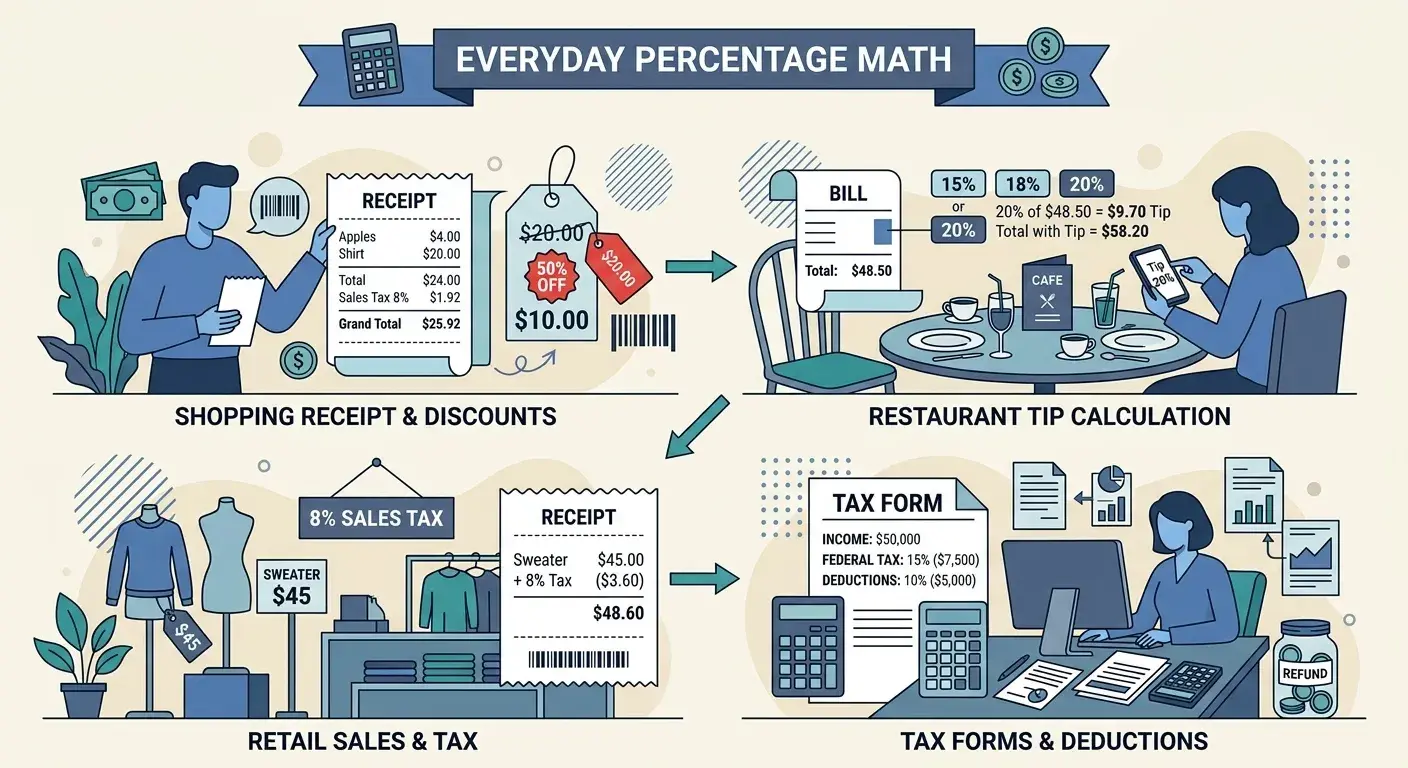
Why Percentage Math Still Trips People Up
Percentage calculations appear constantly — at restaurants, at checkout, on pay stubs, in lease agreements, in job negotiations. Most people know the general concept but freeze when numbers are messy or the direction reverses (calculating the original price from a discounted price, for instance).
The fix isn't memorizing formulas. It's building a mental model for each specific situation. Below are the five scenarios that account for the vast majority of real-world percentage questions.
5 Scenarios with Worked Examples
Restaurant Tips
Example: $63.40 bill, 20% tip
- 10% of $63.40 = $6.34
- Double it for 20%: $6.34 × 2 = $12.68
- Total with tip: $76.08
Shortcut: Move decimal left, double. Done in 3 seconds.
Use the Tip Calculator →Sales Tax
Example: $89 item, 8.5% tax
- $89 × 0.085 = $7.565 → round to $7.57
- Total: $89 + $7.57 = $96.57
Shortcut: Price × rate (decimal). Reverse: total ÷ (1 + rate).
Use the Percentage Calculator →Sale Discounts
Example: $120 jacket, 35% off
- $120 × 0.35 = $42 discount
- OR: $120 × 0.65 = $78 sale price directly
Shortcut: Multiply by (1 − discount %) to jump straight to sale price.
Use the Percentage Decrease Calculator →Salary Raises
Example: $62,000 → $67,000
- Change: $67,000 − $62,000 = $5,000
- $5,000 / $62,000 = 0.0806
- 0.0806 × 100 = 8.1% raise
Shortcut: ((New − Old) / Old) × 100
Use the Percentage Change Calculator →Test Scores & Grades
Example: 34 correct out of 40 questions
- 34 / 40 = 0.85
- 0.85 × 100 = 85%
Shortcut: (Part / Whole) × 100. Same formula, every time.
Use the Percentage Calculator →The Formula Behind All 5 Scenarios
Every calculation above is a rearrangement of one relationship:
- Find the part: Part = Whole × (Percentage ÷ 100)
- Find the whole: Whole = Part ÷ (Percentage ÷ 100)
- Find the percentage: Percentage = (Part ÷ Whole) × 100
Recognizing which rearrangement applies makes any percentage calculation mechanical. For anything you don't want to do by hand, QuickPercent has a calculator for every scenario →
Mental Math Shortcuts for When You Can't Use Your Phone
- 10%: Move the decimal one place left ($73 → $7.30)
- 5%: Find 10%, then halve it ($7.30 → $3.65)
- 20%: Find 10%, then double it ($7.30 → $14.60)
- 15%: Add 10% + 5% ($7.30 + $3.65 = $10.95)
- 25%: Divide by 4 ($73 ÷ 4 = $18.25)
- 50%: Divide by 2 ($73 ÷ 2 = $36.50)
FAQ
What's the quickest way to calculate a 20% tip in your head?
Move the decimal one place left to get 10%, then double it. For a $47 bill: 10% = $4.70, doubled = $9.40 tip. For 15%: find 10%, then add half. $47 bill: $4.70 + $2.35 = $7.05. Practice these two anchors and you'll never need a tip calculator app again for standard percentages.
How do I calculate sales tax on a purchase?
Multiply the price by the tax rate as a decimal. For an $89 item with 8.5% tax: $89 × 0.085 = $7.57 tax, total = $96.57. To work backwards from a tax-included price to the pre-tax amount, divide the total by (1 + tax rate): $96.57 ÷ 1.085 = $89.00. The percentage calculator on this site handles both directions.
How do I calculate a discount from an original price?
Two steps: find the discount amount (original × discount %), then subtract. For a $120 jacket at 35% off: $120 × 0.35 = $42 discount, sale price = $78. Shortcut: multiply the original price by (1 − discount rate) to go straight to the sale price. $120 × 0.65 = $78.
What does percentage change mean and when do I use it?
Percentage change measures how much a value grew or shrank relative to its starting point. Formula: ((new − old) / old) × 100. If your grocery bill went from $320 to $389: ((389 − 320) / 320) × 100 = 21.6% increase. Use this whenever you want to compare change relative to a baseline, not just the raw number.
How do I figure out what percentage one number is of another?
Divide the part by the whole, then multiply by 100. If you scored 34 out of 40 on a test: (34 / 40) × 100 = 85%. If you saved $340 toward a $1,200 goal: (340 / 1200) × 100 = 28.3%. This is the most common percentage calculation — also the one most people try to do in their head when they should just use a calculator.
How do I calculate a salary raise as a percentage?
Same formula as percentage change: ((new salary − old salary) / old salary) × 100. From $62,000 to $67,000: (($67,000 − $62,000) / $62,000) × 100 = 8.1% raise. Going the other direction — if you know the raise percentage and want the new salary — multiply your current salary by (1 + raise rate). $62,000 × 1.081 = $67,022.
What's the difference between percentage increase and markup?
They use the same math but different base values. Percentage increase uses the original price as the base. Markup also uses cost as the base — a 40% markup means selling price = cost × 1.40. Margin uses the selling price as the base, which is why a 40% margin requires a 66.7% markup on cost. These are not interchangeable — make sure you know which base you're working from.
By Jamie Reeves — Personal finance writer focused on practical money math, budgeting, and the numbers behind everyday financial decisions.