April 2, 2026•7 min read•By Marcus Chen
How to Calculate Percentages: Every Formula You Actually Need
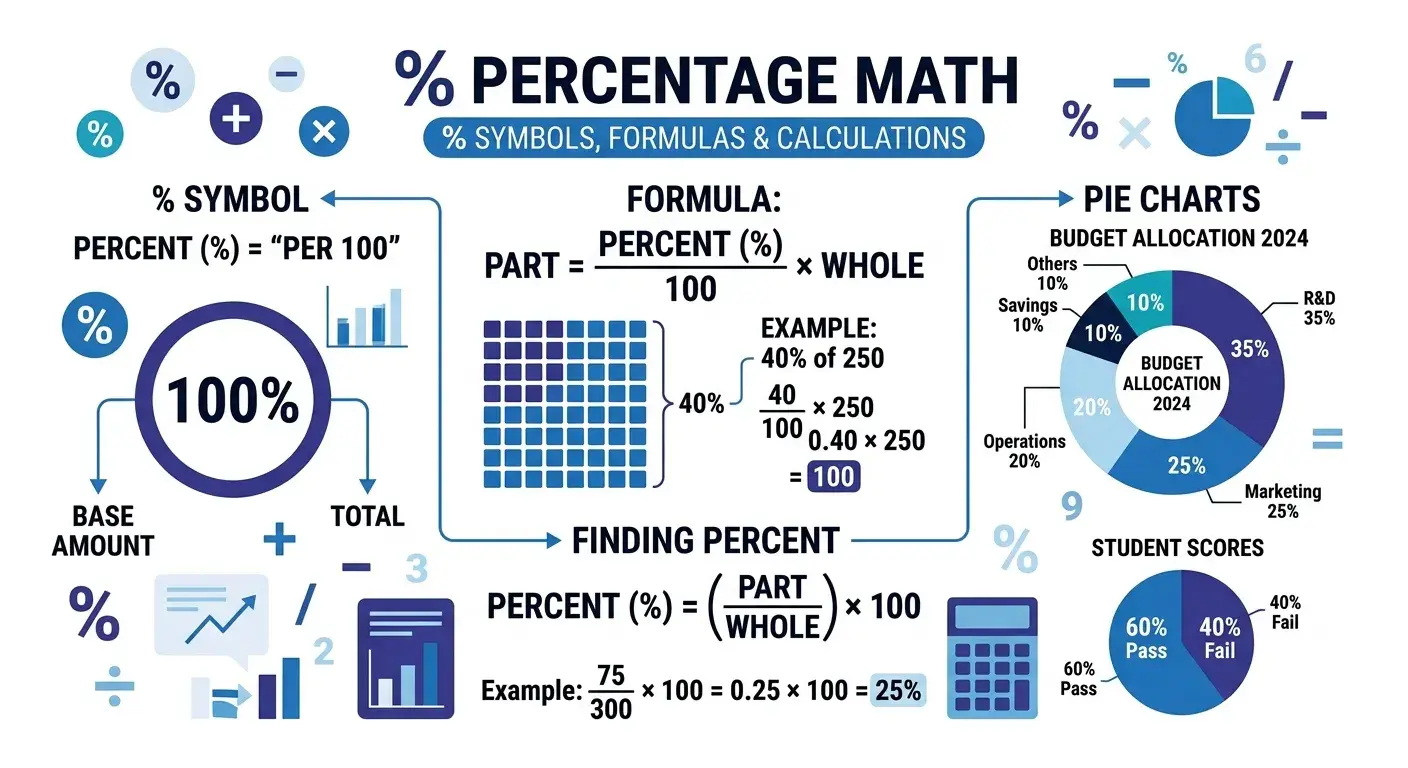
Six percentage formulas cover 99% of real-world math problems. Here's when to use each one, with worked examples and mental math shortcuts.
The 6 Core Percentage Formulas
Mental Math Shortcuts
For quick percentage estimates without a calculator:
- 10%: Move the decimal one place left. 10% of 340 = 34.
- 5%: Halve the 10% result. 5% of 340 = 17.
- 20%: Double the 10% result. 20% of 340 = 68.
- 25%: Divide by 4. 25% of 340 = 85.
- 15% tip: 10% + half of 10%. On $45: $4.50 + $2.25 = $6.75.
- Quick discount check: “30% off $70” → 70 × 0.7 = $49. Think of it as: you pay (100 − discount)%.
QuickPercent Calculators
Skip the formula and get instant answers:
Frequently Asked Questions
What is the basic percentage formula?
The basic percentage formula is: Percentage = (Part ÷ Whole) × 100. To find what percent 30 is of 150: (30 ÷ 150) × 100 = 20%. This formula handles the most common percentage question — 'X is what percent of Y?'
How do you calculate percentage change?
Percentage change = ((New Value − Old Value) ÷ Old Value) × 100. If a price went from $80 to $100: ((100 − 80) ÷ 80) × 100 = 25% increase. If it went from $100 to $80: ((80 − 100) ÷ 100) × 100 = −20% decrease. The sign tells you increase (+) or decrease (−).
How do you calculate a percentage of a number?
To find X% of Y: multiply Y by (X ÷ 100). So 15% of 200 = 200 × (15 ÷ 100) = 200 × 0.15 = 30. Mental math shortcut: 10% is always one decimal place left (10% of 240 = 24), then scale up or down from there.
How do you calculate a tip?
Multiply your bill by the tip percentage as a decimal. For 20% on a $65 bill: $65 × 0.20 = $13. Mental math: find 10% ($6.50), then double it for 20% ($13). For 15%: find 10% ($6.50) and add half ($3.25) = $9.75.
What's the difference between percentage increase and markup?
Percentage increase uses the original value as the base. Markup uses cost as the base to set a selling price. If you buy something for $50 and sell it for $75, the markup is 50% (($75 − $50) ÷ $50 × 100). But the percentage increase from cost to price is also 50%. The formulas are the same — the difference is context.
How do you reverse a percentage (find the original before a percent change)?
Divide by (1 + the percentage as a decimal) for increases, or (1 − the percentage as a decimal) for decreases. If a price is $120 after a 20% increase, the original was $120 ÷ 1.20 = $100. If $80 after a 20% decrease: $80 ÷ 0.80 = $100.